

Musty Smells & AC Mold: Providing service Guide by Saudi HVAC Service
If you live in Riyadh, you battle the dust and the dry heat. But if you live in the coastal cities of Saudi Arabia like Jeddah, Dammam, Al Khobar, or Jubail you face a different, stickier enemy: Humidity.
We all know the feeling of stepping out of the King Abdulaziz International Airport or walking along the Corniche in August. The air feels heavy, your glasses fog up, and you can’t wait to get back into the comfort of air conditioning.
But what happens when that humidity follows you home?
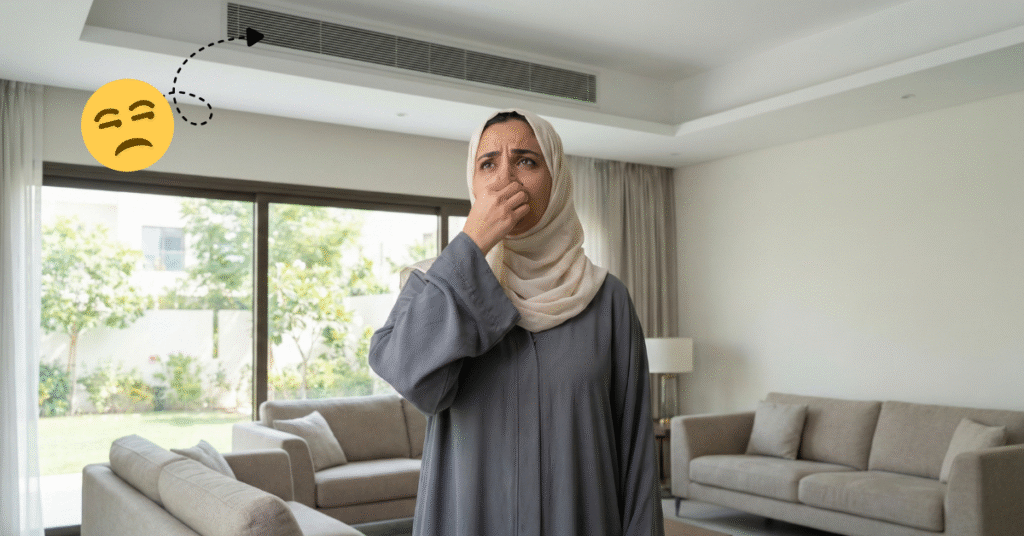
For many coastal residents, there is a recurring nightmare. You turn on the AC expecting a blast of fresh, cool air, but instead, you are hit with a damp, pungent odor. It smells like old gym socks, a wet basement, or rotting leaves. You spray air freshener, burn Oud, and light candles, but the smell always comes back.
That smell is the scent of biology. It is the unmistakable signal that moisture has infiltrated your system and triggered the growth of AC mold.
In this guide, we will explore why homes in Saudi’s coastal regions are uniquely vulnerable to “sweating ducts,” the health risks involved, and how to banish that smell forever.
Table of Contents
The Science of the “Sweat”
To understand why AC mold grows, we first have to understand water.
Your air conditioning system is essentially a machine that makes things cold. The air inside your metal or plastic ducts is chilled to around 12°C to 15°C. Meanwhile, the air outside those ducts in your attic, false ceiling, or crawl space can be 45°C with 80% humidity during a Jeddah summer.
When hot, humid air hits a cold surface, it releases its water. This is the same physics that causes water droplets to form on the outside of a cold can of Pepsi.
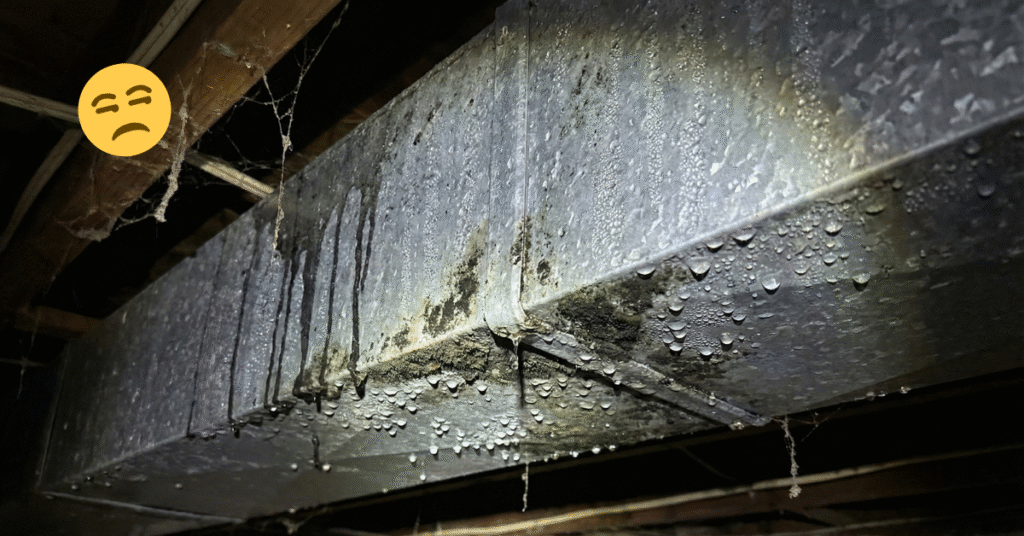
In the HVAC world, we call this “duct sweating.” If your ductwork lacks proper insulation, or if the vapor barrier (the silver foil wrapping) is torn, water will condense on the ducts. In severe cases, this water drips through the ceiling, ruining drywall/gypsum. But more often, it sits there, dampening the dust and debris inside or around the duct.
The Recipe for Disaster: Dust + Water = Food
Mold is a fungus. To grow, it needs three things:
- Spores: These are microscopic and are everywhere in the air.
- Temperature: It loves the warm-to-cool range found in AC systems.
- Food: Dust.
Saudi Arabia is dusty. Even in the cleanest villas, fine particulate matter settles inside the ducts over years. Dry dust is mostly harmless. But when you add the condensation from our humid coastal weather to that dust, it turns into a wet sludge.
This sludge is the perfect breeding ground for AC mold. Once a colony establishes itself inside your dark, damp ductwork, it feeds on the dust and releases spores (and that terrible smell) every time the fan turns on.
The Health Risks of a “Sick” System
Ignoring the smell isn’t just an annoyance; it is a health hazard. The term “Sick Building Syndrome” is often linked to HVAC contamination.
When AC mold grows in your supply vents, the system acts like a spore cannon, blasting microscopic particles into your bedroom, kitchen, and majlis. For healthy adults, this might just cause a bit of throat irritation or a headache.
However, for vulnerable groups young children, the elderly, or anyone with asthma or allergies exposure to AC mold can cause serious respiratory issues. Symptoms often include:
- Chronic coughing or sneezing.
- Watery, itchy eyes.
- Skin rashes.
- Worsening of asthma symptoms.
If you notice that your family’s allergies get worse when they are at home and improve when they leave, your ductwork is a prime suspect.
Identifying the Problem
Since you cannot easily see inside your ducts, you have to rely on other senses.
1. The “Dirty Sock” Syndrome: This is the most common sign. If the air smells musty, earthy, or stale, specifically when the AC unit kicks on, it is a strong indicator of bacterial or fungal growth on the evaporator coil or in the ducts.
2. Visible Growth on Vents: Look at your ceiling diffusers (the plastic or metal vents). do you see tiny black or dark green speckles forming on the slats? That is likely not dust. That is AC mold growing on the condensation that forms on the cold vent. If it is on the vent, it is almost certainly deeper in the duct too.
3. Water Stains: Yellow or brown rings on your ceiling gypsum board usually mean the ducts above are sweating so much that water is pooling and dripping.
Solutions: How to Stop the Sweat and the Smell
Combating this issue in humid cities like Jeddah and Dammam requires a two-pronged approach: Moisture Control and Sanitation.
1. Upgrade Your Insulation (The Vapor Barrier)
The most effective way to stop the sweating is to stop the hot, humid attic air from touching the cold duct.
- Inspect the insulation: Over time, the silver foil wrapping on ducts can peel or tear. A professional team needs to reseal these gaps using specialized mastic and tape.
- Increase thickness: In coastal areas, standard insulation might not be enough. upgrading to a higher “R-value” insulation ensures the surface of the duct stays above the dew point, preventing the moisture that AC mold needs to survive.
2. Professional Cleaning and Sanitation
If the smell is already present, insulation alone won’t fix it. The colony is already there. You need professional remediation.
- Physical Cleaning: Technicians use rotobrush machines to physically scrub the slimy dust sludge off the inner walls of the ducts.
- Chemical Sanitation: After cleaning, the system should be fogged with an EPA-approved antimicrobial agent. This kills the remaining spores and prevents regrowth. This is the only way to truly eliminate the smell associated with AC mold.
3. Install UV Lights
For a long-term solution, many homeowners in humid climates install UV-C germicidal lights inside the AC unit, near the coil. This intense ultraviolet light creates a zone where biological growth cannot survive, keeping the heart of your system sterile.
Conclusion
Living by the Red Sea or the Arabian Gulf offers beautiful views and a relaxed lifestyle, but it requires vigilance when it comes to home maintenance. The humidity that frizzles your hair is doing much worse damage to your home’s cooling system.
Don’t let a musty smell become the background scent of your life. It is not “just the weather.” It is a sign that your home’s lungs are congested.
By addressing insulation failures and scheduling professional sanitation, you can stop the condensation, kill the AC mold, and breathe fresh, clean, and odorless air once again. Your lungs (and your nose) will thank you.
Location: Industrial City, Al Sina’iyah, Riyadh, Saudi Arabia